Throughout history, Americans have learned several lessons. These lessons include the importance of transportation, the cost of freedom, how to recover from a National state of Depression, the positive and negative effects of advancements in weaponry, and the media's ability to influence. These lessons were key in the development and progression of America.
One Lesson learned from American History was the importance of transportation. Transportation in America went through great advancements. Begining with the Pacific Railway Act passed July 1, 1862. The purpose of this act was to empower the Union Pacific Railroad Company to lay out, locate, construct, furnish, maintain. and enjoy a continuous railroad and telegraph system. This telegraph and railway system was the first connection made between the east and the west. The Panama Canal was another great advancement in transportation. The Panama Canal was bought from Columbia and would cost the U.S. $380 million to complete. The Canal would provide a quicker route for shipping goods from the Atlantic to Asia. Another advancement in technology was the car. By the Economic Boom, the average American citizen did not look at a car as a luxury but a necessity. In 1907, the cost of a car was $2123 and by 1924 the price dropped to $290. The progression of transportation was an important factor in American History.

The United States has always been admired as a place of opportunity. As the U.S. began its expansion westward, more and more people arrived in America. Immigrants from southern and eastern Europe such as Italy, Greece, Poland, Hungary, and Russia came to escape war, famine, religious persecution, and trouble farming. However, freedom came at a cost to many immigrants. Rather than being welcomed they often faced discrimination. Their homes were crowded, unsanitary, hazardous, and cheap apartments known as tenements. Immigrants faced long, hard work hours with extremely low wages and no workman's compensation. Immigrants found that freedom comes at a cost.

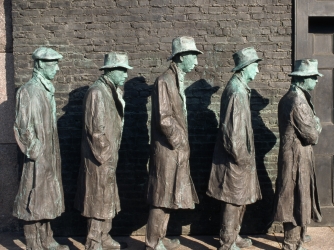
The Great Depression was a result of easy access to credit, the increase in the gap between the rich and poor, the farming crisis, and problems with the stock market. The Great Depression resulted in homelessness, breadlines and soup kitchens, Shantytowns, Hoover Flags, and an ease in immigration. The national state of depression led FDR to create the New Deal. The New Deal required that the federal government provide immediate assistance to the American people in the form of relief, recovery, and reform. FDR's first action to pulling the United States out of the depression was through creating a bank holiday. March 6, 1933, all banks were closed and were to remain closed until passing an inspection. The next step was to pass the Emergency Banking Bill. March 9, 1933, all banks that could meet financial obligations of their customers were allowed to reopen. The final step was the implication of Fireside Chats. March 12, 1933, on the subject of banking, FDR delivered his first chat as to explain his call to action and his plan of action. These responses were what pulled America out of a nationwide Depression.

Advancements in technological warfare have affected the approach and declaration of war. For instance, weapon advancements such as the machine gun resulted in mass killings. "The Wounded Knee Massacre" is infamous for the slaughter of 300 Indians including old men, women, and children. WW1 was the first war to incorporate U-boats in battle. These German submarines would sink British passenger ships off the coast of Ireland. The first atomic bomb was dropped on the Japanese city of Hiroshima, August 6, 1945. This single bomb wiped out 90 percent of the city, instantly killed 70,000 people and more later due to radiation poisoning. These improvements in warfare have affected the consideration of the approach and declaration of war.

The media has always been influential in the perceptions of the public. For example, the Spanish American war was ignited by yellow journalism. Yellow Journalists are publishers who exaggerated headlines to sell papers. In the case of The Spanish American War, William Randolph Hearst and Joseph Pulitzer publication pushed America to support Cuban Rebels. Propaganda is one of history's most popular means of gaining the support of the American public. Through pictures and phrases propagandas intention is to persuade the people's attitudes and beliefs. Propaganda became increasingly popular in times of war to encourage the buying of war bonds, enlistment, and conservation of food and fuel. Muckrakers are journalists who uncovered and exposed a wide range of major problems. Famous muckrakers included Jacob Riis, Lincoln Steffens, Ida Tarbell, Upton Sinclaire, and Thomas Nast. These journalists emphasized the need for a social or moral transformation. Media is an influential source of the perceptions of the public.

Americans have learned several lessons throughout its development. These lessons include the importance of transportation, the cost of freedom, how to recover from a National state of Depression, the positive and negative effects of advancements in weaponry, and the media's ability to influence. These lessons were key in the development and progression of America.
Hatmaker, Alicia. "America Enters The War." Athens Drive High School. Lecture.
Hatmaker, Alicia. "Inro to Westward Expansion." Athens Drive High School. Lecture.
Hatmaker, Alicia. "Pacific Railway Act." Athens Drive High School. Lecture.
Hatmaker, Alicia. "Native Interactions." Athens Drive High School. Lecture.
Hatmaker, Alicia. "Coming to America." Athens Drive High School. Lecture.
Hatmaker, Alicia. "Intro to Progressivism." Athens Drive High School. Lecture.
Hatmaker, Alicia. "Imperialism Expands." Athens Drive High School. Lecture.
Hatmaker, Alicia. "The Spanish American War." Athens Drive High School. Lecture.
Thompson, Heather Ann. "History." History, 28 Dec. 2017, www.history.com/news.
Accessed 7 Jan. 2018.




![FDR in 1933 (Photo: Elias Goldensky (1868-1943) [Public domain], via Wikimedia Commons)](https://www.biography.com/.image/t_share/MTE1ODA0OTcxNzcxODU2Mzk3/franklin-roosevelt-9463381-1-raw.jpg)